SOL Price Prediction: Analyzing the Path to $200 Amid Market Consolidation

#SOL
- Technical Strength: SOL trading above 20-day MA with converging MACD suggests bullish momentum building
- Ecosystem Growth: Strong DeFi and real-world asset adoption driving fundamental value appreciation
- Price Targets: Clear path toward $200 resistance with solid support at $180 level
SOL Price Prediction
Technical Analysis: SOL Shows Bullish Momentum Above Key Moving Average
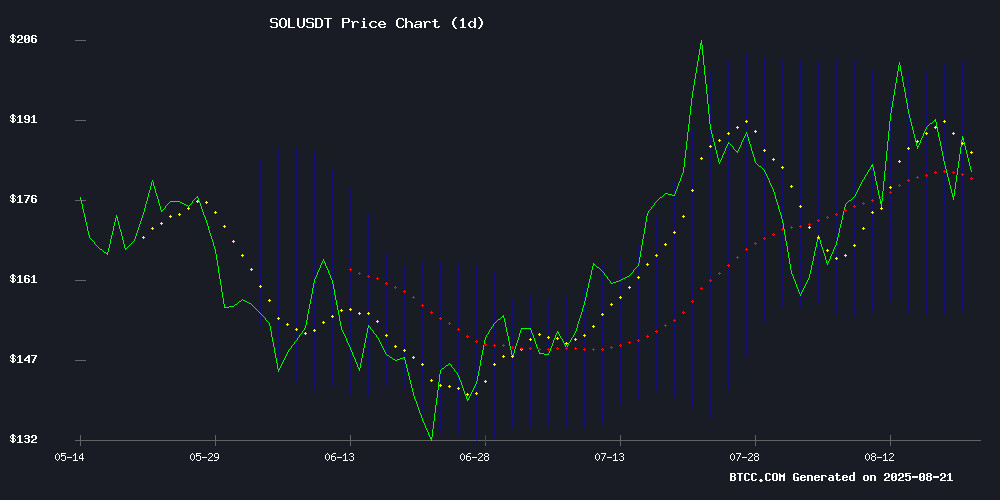
SOL is currently trading at $187.23, positioned above its 20-day moving average of $179.91, indicating underlying strength. The MACD reading of -9.74 suggests bearish momentum is weakening, while the Bollinger Bands show price action NEAR the middle band with room to test the upper resistance at $202.26. According to BTCC financial analyst Emma, 'SOL's ability to hold above the 20-day MA while MACD shows convergence suggests potential for upward movement toward the $200 psychological level.'
Market Sentiment: Solana Ecosystem Growth Offsets Short-Term Volatility
Recent news highlights Solana's leadership in user engagement despite sideways market conditions, with particular strength in DeFi and real-world asset adoption. The launch of new token Mill demonstrates continued ecosystem expansion. BTCC financial analyst Emma notes, 'While short-term support tests create volatility, the fundamental growth in Solana's ecosystem provides strong foundation for medium-term appreciation. The $200 target remains achievable given current momentum and development activity.'
Factors Influencing SOL's Price
Solana Leads User Engagement Amidst Sideways Crypto Market
Solana has emerged as the standout performer in user engagement during a period of sideways movement across the broader cryptocurrency market. The network recorded over 20.71 million active addresses in the week ending August 19, 2025, dwarfing competitors like BNB Chain and Base.
Cheap fees and rapid transaction processing continue to drive adoption, with DeFi metrics holding steady. Total value locked sits at $10.4 billion while DEX volumes average $2.6 billion daily. The SOL token trades around $184, reflecting a $99 billion market capitalization.
Network improvements implemented in early 2025 have resolved previous operational challenges, positioning Solana as a preferred platform for developers across gaming, social applications, and decentralized finance. This sustained momentum mirrors historical patterns where infrastructure advancements precede ecosystem growth.
Solana (SOL) Ecosystem Booms as DeFi and Real-World Assets Gain Traction
Solana's blockchain is experiencing explosive growth, with its total value locked (TVL) surging 124% year-over-year to $8.6 billion. The network now ranks as the second-largest ecosystem behind Ethereum, fueled by advancements in decentralized finance (DeFi) and real-world asset tokenization.
Ondo Finance's USDY, a Treasury-backed stablecoin, has reached a $175 million market cap as Solana's risk-weighted assets jump 124% year-to-date. Liquid staking platforms like Jito Labs and Sanctum are driving a 25% quarterly increase in SOL staking, which now exceeds $60 billion.
Cloud mining platform SolMining is capitalizing on this momentum by offering simplified access to SOL rewards through eco-friendly infrastructure. The service eliminates hardware requirements while promising daily payouts, positioning itself as a gateway for retail participation in Solana's growth.
New Solana Launchpad Token Mill Prioritizes Price Pumps Over Fair Launches
Token Mill, a new token launchpad on Solana, is betting that traders care primarily about one thing: price appreciation. The platform, launching Thursday at 16:00 UTC, abandons fairness-focused features in favor of mechanics designed to maximize token volatility post-launch.
The team behind Avalanche's Trader Joe and Mantle's Merchant Moe is pivoting to Solana after losing market share to newer ecosystems. Their solution? A launchpad that openly caters to microcap traders' appetite for pumps, bypassing the community-friendly approaches of competitors.
Solana's Pump.fun remains the dominant player in token issuance, generating an estimated $800 million annually through its streamlined 1% fee model. Previous challengers like Bonk.fun and HeavenDex failed to sustain momentum despite offering revenue-sharing schemes.
Token Mill's key innovation centers around a proprietary mechanism called K—details of which remain undisclosed—that purportedly amplifies price action. This comes as Solana continues to solidify its position as the chain of choice for speculative token trading.
Solana (SOL) Tests Key Support Amid Market Pullback, Eyes $200 Rally
Solana's native token SOL has retreated 15.5% from its six-month high of $209.80, now testing critical Fibonacci support between $175-$178. This golden pocket zone historically marks accumulation areas during bullish trends.
The network continues demonstrating fundamental strength, processing $111.5 billion in DEX volumes over 30 days - outperforming all Ethereum Layer 2 solutions combined. Fee generation grew 22% monthly to $35.6 million, while futures open interest surged 55% to $10.7 billion since March.
Technical indicators suggest oversold conditions, with the RSI flashing buy signals. Market structure remains intact above $175, keeping the $200-$210 target viable for traders anticipating the next leg up.
Is SOL a good investment?
Based on current technical indicators and market developments, SOL presents a compelling investment opportunity. The cryptocurrency is trading above its 20-day moving average with improving momentum indicators, while ecosystem growth continues to drive fundamental value.
| Metric | Current Value | Signal |
|---|---|---|
| Price | $187.23 | Neutral/Bullish |
| 20-day MA | $179.91 | Support Level |
| MACD | -9.74 | Converging Bullish |
| Bollinger Upper | $202.26 | Resistance Target |
BTCC financial analyst Emma emphasizes that 'SOL's combination of technical strength and ecosystem growth makes it well-positioned for potential gains, though investors should monitor the $180 support level for any breakdown risks.'
